Summarize this page with
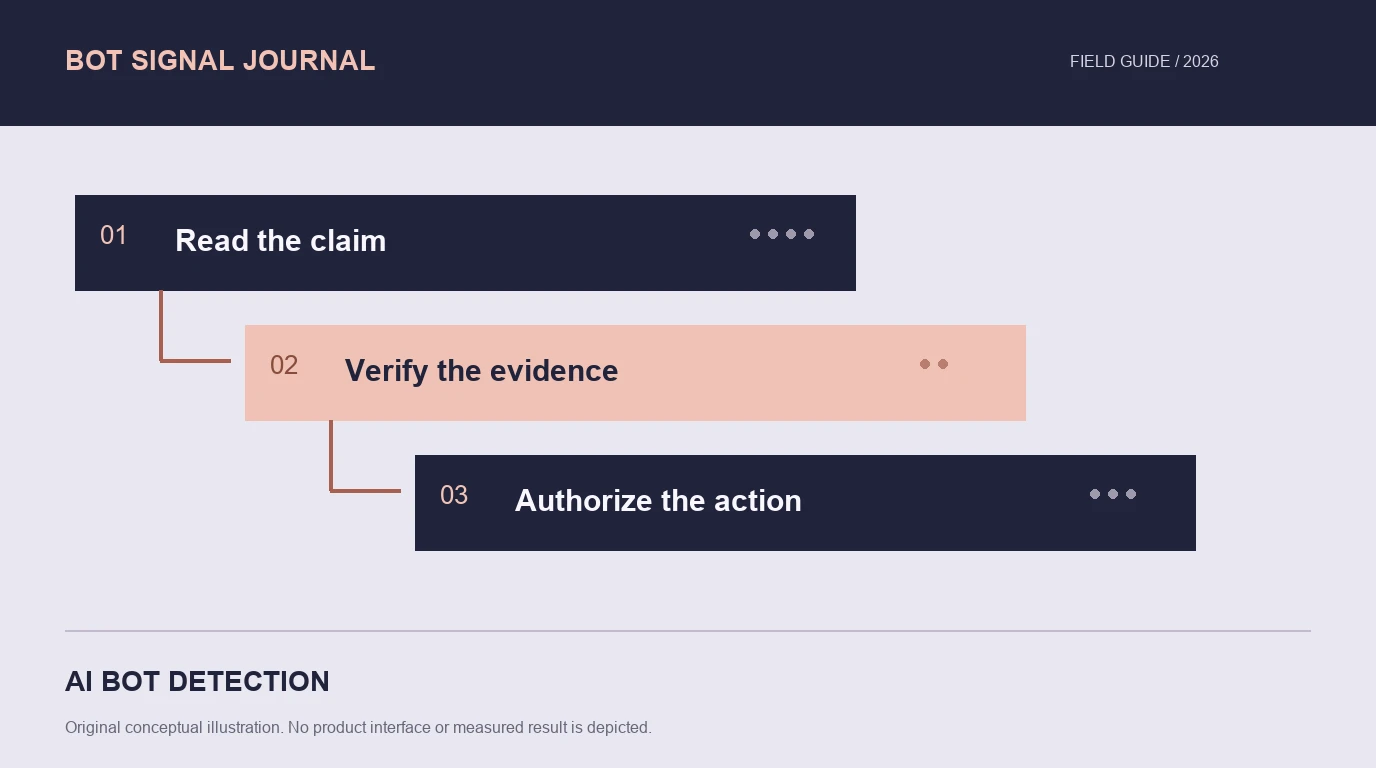
AI bot detection answers whether observed traffic shows automation. Agent verification asks which supported client or provider is making the request. Authorization decides what that client may do on a route. Keep those questions separate: a browser agent can be automated and legitimate, while a declared name alone does not establish identity or permission.
The distinction is useful for product teams serving both ordinary visitors and software acting for them. A search crawler, a customer’s browser agent and a script creating promotional accounts can require different treatment. The comparison includes products with different evidence and control models.
- 1Read the claim
- 2Verify the evidence
- 3Authorize the action
Three decisions that should remain distinct
| Decision | Evidence needed | Example outcome |
|---|---|---|
| Automation classification | Supported request, browser or behavioral observations | The session appears automated |
| Client verification | A supported provider-verification mechanism | The claim matches a recognized client |
| Route authorization | Product policy and the requested action | The client may read a public page but not create accounts |
A verified identity does not establish that every request from that client should be allowed. Equally, a customer-authorized agent does not become abusive solely because it automates a browser. Record the classification and permission decision separately so an incident review can explain the actual reason for a response.
Start with a claim, then verify it
User-agent text is easy for a client to supply. Treat it as a declared label until a supported verification mechanism establishes more. Providers may document address verification, reverse/forward DNS checks or cryptographic methods for particular clients.
Cloudflare’s bot verification reference separates Web Bot Auth and IP validation. Google’s crawler-verification guide describes supported methods and different crawler/fetcher categories. Follow the mechanism for the actual provider rather than copying a hostname suffix into a universal allow rule.
Keep an unavailable verification result distinct from a failed claim. Stale address data, a network error and an invalid identity are different conditions. Your route policy can decide how to handle each without turning missing evidence into a verified identity.
Browser-using agents change the available clues
An agent can use a real browser engine, execute JavaScript and maintain a session. That means a simple no-JavaScript rule or obvious headless property will not cover every agent. Device/network consistency and the sequence of actions can supply context, depending on the selected product.
ShieldLabs bot detection includes bot, browser-automation and AI-traffic detection alongside current device/network evidence. The result can add visitor, user, device and IP risk context and ready-made account-level abuse detection. Detecting that activity does not, by itself, establish the identity of an AI provider.
Fingerprint, DataDome and Cloudflare have their own signal, agent and policy scopes. Compare the exact product and plan rather than assuming every AI-related feature is available through the same event or endpoint.
Define permission by the resource and action
Public reading, authenticated account access, form submission and checkout have different consequences. A route that permits a recognized crawler can still need rate controls. A customer-authorized agent may need an authenticated account relationship before making a purchase or changing settings.
Document the legitimate machine clients your application supports. Include monitors, partner integrations and CI as well as AI agents. A blanket browser challenge across all routes can break those integrations without improving protection for the sensitive actions.
Akamai’s discussion of granular AI-bot controls provides another product perspective on policy separation. Such controls should be evaluated against the actual deployment rather than inferred from a vendor’s category label.
Build an evaluation that preserves the distinctions
Use authorized examples of declared crawlers, verified integrations, browser automation and legitimate human sessions. Record what identity was claimed, whether it was verified, what automation evidence was returned and which action was requested.
Do not label all automation as fraud in the test dataset. That would make a permitted partner client appear to be a detection miss whenever the product allows it. Define the positive class for each measurement: automation classification, invalid identity or unauthorized action.
Then count result availability and legitimate failures. A detector can correctly recognize automation while the application applies an inappropriate block. The false-positive guide explains that difference, and the API/edge guide shows where the decision can run.
Choose a result your team can operate
A useful result preserves the client claim, verified identity where available, observed automation and event context. The application also needs a documented response when any of those fields is unknown. Avoid forcing them into a single permanent label that outlives the evidence.
Use the checker directory to inspect relevant output, then evaluate account-enabled features on your own supported routes. The goal is understandable access for legitimate software and people, with protection against the actions the product does not permit.
FAQ
Does detecting AI traffic identify the AI company?
Not necessarily. Automation evidence and verified provider identity are separate outputs. Check which verification mechanisms and client labels the chosen product actually supports.
Should a verified agent always be allowed?
Verification establishes a supported identity claim. Permission still depends on the route, authenticated relationship, rate and action the application allows.
Does robots.txt enforce account-access policy?
It communicates crawling preferences to clients that follow it. Authentication, request controls and supported verification remain necessary for protected application actions.
Sources
- Cloudflare bot verification methods.
- Google crawler and fetcher verification.
- ShieldLabs bot detection.
- Akamai: granular AI-bot controls.
Continue reading
- Bot detection false positives: count legitimate outcomes
- Bot detection API vs edge protection: integration choices
Compare all eleven tools or read the complete deployment guide.