Summarize this page with
A bot detection API delivers evidence to an application-controlled workflow. Edge protection evaluates traffic in the request path before origin. Browser collection can supply additional observations to either model when supported. Choose by route coverage, trusted result delivery and response timing rather than assuming that one deployment shape solves every bot problem.
The ranked comparison contains identification products, managed bot platforms and challenge-based assessments. Some products combine several integration models, so inspect the specific product and connector proposed for your application.
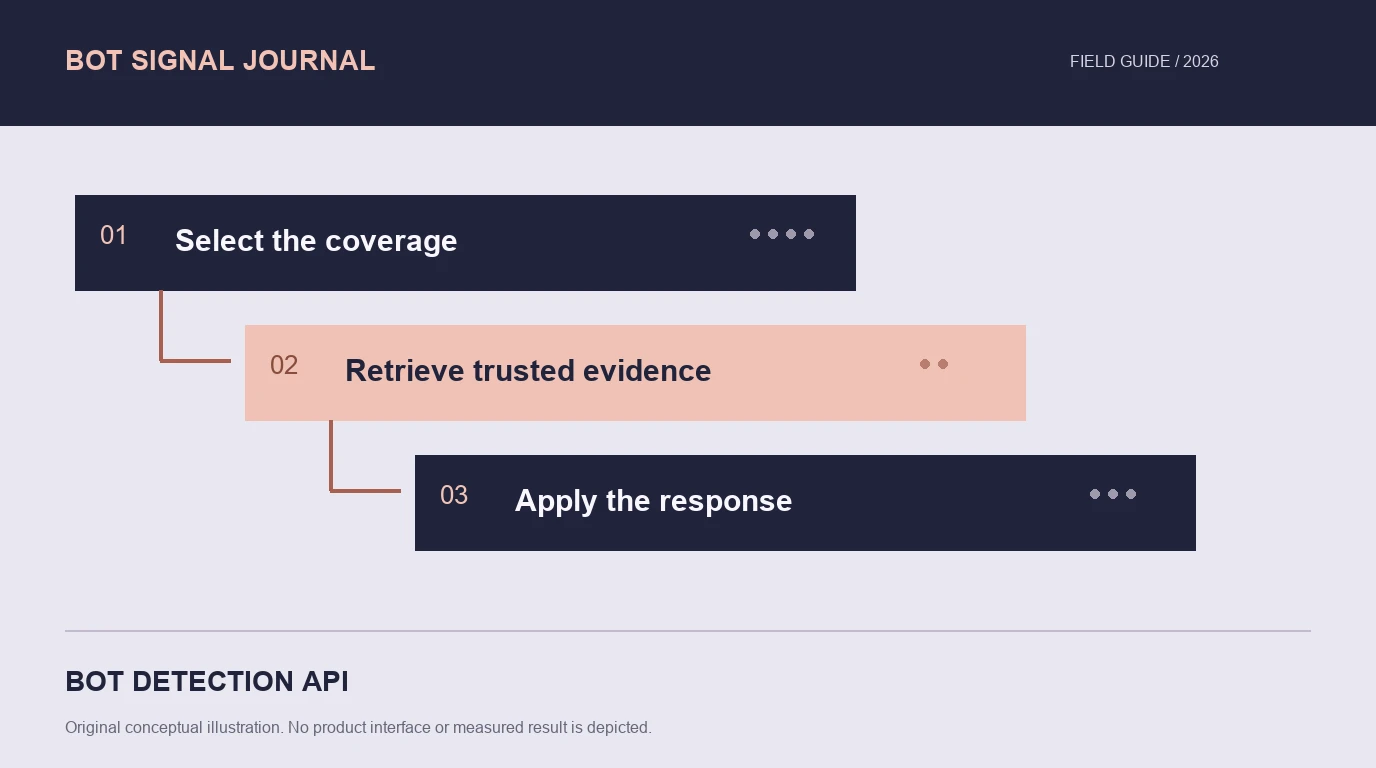
- 1Select the coverage
- 2Retrieve trusted evidence
- 3Apply the response
Draw the route before choosing the product
Map where traffic arrives, which components can inspect it and when the protected action completes. A CDN, reverse proxy, browser script and application backend observe different parts of that path.
An edge policy can reject or challenge a request before it reaches origin. An application can use a backend assessment beside account history and business rules. A browser event can add device or environment observations, but only where the supported collection runs.
Do not equate a product’s API with an IP-only lookup. An API can retrieve an observed event, validate a challenge or provide a platform control surface. Ask which evidence is being supplied and whether the response is associated with the action you intend to protect.
Compare coverage and ownership
| Deployment | Useful fit | What the team must verify |
|---|---|---|
| Edge bot management | Request-path protection and route policies | Traffic routing, plan fields, legitimate integrations and rollback |
| Supported platform connector | Protection beside existing application delivery | Connector version, telemetry and enabled endpoint scope |
| Browser collection plus backend result | Device/session context at account actions | Collection placement, result association and unavailable states |
| Challenge assessment | Verification at a specific interaction | Token validation, completion and recovery |
| Authenticated machine-client route | Partner, CI or service traffic | Credentials, authorization and appropriate supported protection |
Cloudflare’s bot documentation describes its product boundaries. F5’s Bot Defense overview documents inline and API-mode options with different setup requirements. Those examples show why an entire vendor should not be labeled as one immutable deployment type.
Keep browser evidence and backend trust distinct
A browser script can collect observations, but the application needs a trusted way to retrieve or validate the provider’s result. Keep private credentials on the server and follow the supported client/server association.
An ordinary form field saying “human” or carrying an arbitrary risk number is not enough. The backend should establish that the result is valid for the intended action before completing it. Avoid reusing a previous assessment indefinitely after the device, route or account context changes.
ShieldLabs documentation covers its snippet, SDK, API and webhook routes. ShieldLabs combines bot/AI-traffic detection with current device/network and account-risk context. Fingerprint’s quick-start guide supplies another event-based integration model. Compare the actual result path and field entitlement.
Account for clients that do not run the page
A JavaScript-protected browser flow does not automatically cover every native mobile or machine-to-machine request. Verify the provider’s SDK, connector and client support for each route rather than treating an absent browser event as proof of abuse.
Partner APIs and monitoring should have an appropriate authenticated or verified path. Public read-only endpoints and benefit-granting actions can also need different controls. Document the legitimate clients before applying a domain-wide challenge mode.
For F5, the deployment-planning documentation recommends a test environment before production. The exact infrastructure and account enablement remain part of that evaluation; the documentation route is not a public checker.
Define deadlines and missing-result behavior
The protection layer must fit the application’s response budget. Evaluate end-to-end completion, not only the provider’s advertised processing time. Collection, network requests, backend retrieval, retries and user verification can all contribute.
An assessment timeout, an invalid token and a negative detection are different outcomes. Rate limits and exhausted allowances also need explicit handling. Store a clear internal outcome state rather than silently converting all failures into either human traffic or abuse.
A simple internal record can preserve those distinctions. The following is an application model, not a vendor response contract:
protected_action: login
assessment_state: available | unavailable | invalid
provider_result_reference: validated reference when available
provider_score_meaning: documented subject and direction
application_outcome: allow | verify | review | restrict
Preserve the provider’s original result and timestamp alongside that model where appropriate. This makes a user complaint or false restriction easier to investigate.
Evaluate operational change, not just detection
Run permitted automation and legitimate controls through the same supported routes. Confirm what reaches origin, what the backend receives, which response applies and whether users can recover. Include rollback and observability in the pilot.
Count the actual billing unit at those events. An edge request, a challenge assessment and a device identification are not automatically equivalent units. The cost guide explains the commercial comparison.
Use the checker directory for interface exploration and the complete guide for the broader shortlist. The right integration is the one whose evidence and response your team can operate consistently across the routes it claims to protect.
FAQ
Is every bot detection API an IP lookup?
No. It may return address intelligence, retrieve a browser/device event, validate a challenge or expose platform controls. Read the documented subject and collection requirements.
Does an edge product replace account-risk context?
It can add request-path protection, but the account and business-action requirements still need evaluation. Products may offer additional account features under separate scopes.
Can I use browser collection for every API caller?
Only where the caller and route support that collection. Native mobile, partner and machine-to-machine clients need a documented integration path of their own.
Sources
- Cloudflare Bots documentation.
- F5 Bot Defense overview and deployment planning.
- ShieldLabs documentation.
- Fingerprint quick-start guide.
Continue reading
- Bot detection methods: read the evidence at each layer
- Bot signups and promo abuse: connect device and account
Compare all eleven tools or read the complete deployment guide.