Bot signups and human-operated benefit abuse
Passing a human check is not the same as meeting a product eligibility rule. Protect grants, seats and rewards with their own records.
Summarize with AI
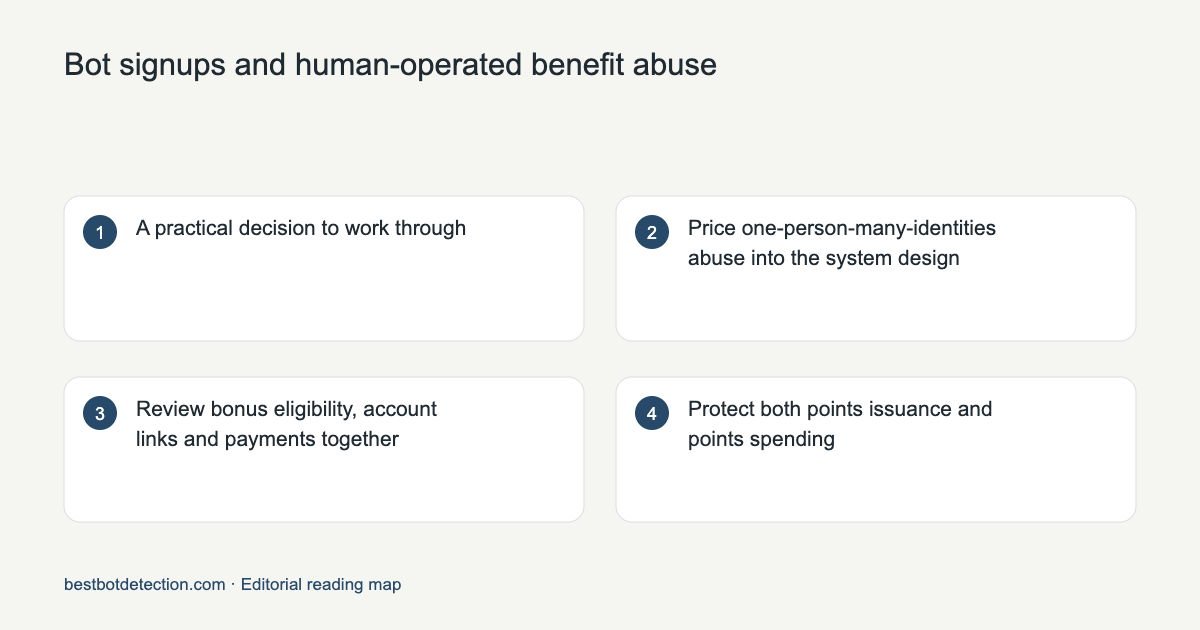
A practical decision to work through
Imagine a challenge stops a scripted burst but one operator manually creates a new trial each morning. The bot graph improves while service cost continues. Add eligibility and account relationships before the next grant, with an appeal for genuine coworkers.\n\n| Control | What it establishes | What still needs evidence |\n| --- | --- | --- |\n| Request challenge | Supported request verification | Trial eligibility |\n| Account/device link | A relationship estimate | Whether policy allows the relationship |\n| Grant ledger | Prior issued value | Identity and context of a disputed match |
Price one-person-many-identities abuse into the system design
A request can be human and still belong to a many-identity claim farm. Sybil defenses need the system's actual independence or eligibility rule. Microsoft Research's Sybil paper explains the identity problem; combine appropriate scarcity, reputation, account/device links and on-chain evidence for airdrops. Keep confidence and an appeal path. A browser challenge cannot prove one wallet per person or establish every beneficial owner, even when the network appears ordinary.
Review bonus eligibility, account links and payments together
Bots can submit many claims, but eligibility and coordinated human play require account relationships too. Keep bonus terms, payment ownership, KYC and location controls separate in the review. ShieldLabs, Verisoul and SEON are candidates for device/account risk; none should be presented as replacing age or jurisdictional checks. Evaluate legitimate players sharing devices alongside repeat claimants. Advice to players should center on following terms and requesting review rather than evasion.
Protect both points issuance and points spending
Separate automated balance probing from misuse of earned points and takeover of a genuine loyalty account. Protect profile changes and redemptions with authentication, keep the points ledger auditable and join device/session history to the redemption. Family programs and gifts can produce normal sharing. A bot flag supplies timing and request evidence, while the earning and reversal records decide whether the reward exists and is eligible.
Pay for qualified referrals after the outcome is known
Referral bots can generate clicks and inboxes without producing a qualifying customer. Pay on the defined activation, purchase or hire, then reconcile refunds and cancellations. Device/account links help detect self-referrals; a shared workplace does not prove them. Track the invitation path and ownership of campaign codes. A detector that reports bot-free clicks still needs the attribution and reward ledger to establish what the partner earned.
Enforce promotion eligibility at redemption
A coupon redemption should validate eligibility independently of whether the user seems human. Stripe distinguishes coupon configuration from a customer-facing promotion code. Enforce product, stacking and customer limits at the server, and relate repeated claims through device/account evidence. Phone intelligence from SEON or Verisoul can add context but shared or recycled numbers need review. Reserve the discount once under concurrent checkout attempts and preserve the offer terms.
Limit compute exposure before the first expensive job
For an AI trial, protect the expensive job endpoint even if signup is quiet. Reserve credits atomically, cap concurrency and unlock larger workloads after suitable verification. A low-rate user can consume costly compute without looking like a request flood. Use account/device evidence to review repeated grants, and let an uncertain new customer try an inexpensive preview. Compare saved service cost with legitimate successful generations and paid conversion.
Protect the entitlement, not just the registration form
Blocking scripted signups reduces volume but leaves human-operated serial trials. Define whether eligibility belongs to a person, workspace or organization, and check the benefit ledger before provisioning. Device/account platforms such as ShieldLabs, Verisoul and Castle add links that email alone lacks. At fifty thousand signups, count the additional logins, retries and protected actions when pricing. Measure useful legitimate activation instead of celebrating a lower registration count.
Distinguish sharing from normal multi-device use
A subscription's automation policy should not accidentally become a device-limit policy. A user may legitimately use a phone, laptop and TV; several people sharing one paid account is another issue. Analyze concurrency and account history against explicit terms. ShieldLabs provides sharing detection, while billing and access systems implement an appropriate notice, seat upgrade or fresh authentication. Keep travel and replacement devices in the legitimate evaluation set.
Make a device ban specific, appealable and observable
A moderation restriction needs a record of what was restricted and why. Link a suspected returning account through history and repeated conduct, then review device/network evidence. An office machine, public computer or reassigned address can be shared. Provide an expiry and appeal route instead of making a fingerprint permanent punishment. The term ban evasion covers avoiding a service restriction; legal consequences depend on particular conduct and jurisdiction.
Link accounts with reasons that an analyst can review
Automation detection and duplicate-account linking produce different outcomes. One human can run many accounts, while one account can receive legitimate automated activity. Compare ShieldLabs, Verisoul and Castle on explainable relationship evidence and review handling. A gaming example should include siblings on a shared console and one operator clearing storage between claims. Geolocation or anti-detect flags add context; they do not independently establish a unique person or regulatory compliance.
Evaluate signup risk before an account receives value
A good bot defense still needs an account model. Email verification shows inbox access; repeated actors can control many inboxes and real users can share equipment. Compare device/account links from ShieldLabs, Verisoul, Castle and SEON, then enforce privileges before issuing value. Use identity proofing when real-world identity is required. Test a legitimate mobile signup with failed collection beside a scripted registration that succeeds through the browser challenge.
Sources
- Sybil official source · read
- Nist official source · read
- Shield official source · read
- Promotion official source · read
- Seon official source · read
- Verisoul official source · read
- Dispute official source · read
- Auth official source · read
- Session official source · read
- Refund official source · read
- Logging official source · read
- Idem official source · read
- Coupon official source · read
- Trial official source · read
- Rest official source · read
- Castle official source · read
- Challenge official source · read
- Fraudfilter official source · read
- Fraudfilterprice official source · read
- Adpolice official source · read
- Authorization official source · read
- Auth0 official source · read
- Onetrust official source
- Oauth official source · read
- Oauthsecurity official source · read
- Fpprivacy official source · read
Continue reading
- Bot controls from request to account
- Browser recognition for bot investigations
- Bot traffic through proxies and relays
- Bot protection for commerce and content
- Measure bot mitigation with customer outcomes
- Buy bot and fraud protection by workflow
- Free bot detection tools and cost
- Ai agent vs bot detection
- Prevent bot signups and promo abuse
- Public checkers and vendor demos
- More research guides
FAQ
What trial does FraudFilter advertise?
FraudFilter.io advertises a seven-day trial without a credit card. Its pricing page lists 199 US dollars per month and a separate fifteen-day refund policy. The refund window is not the trial duration, and similarly named products may be unrelated. Verify the exact domain and current terms before purchasing.
Does AdPolice provide an instantly accessible free trial?
Its official site currently offers a Free Brand Check and a guided demo. The brand check requests contact details and follow-up analysis; it is not evidence of instant full-platform access. Use the official terms to establish a pilot, and distinguish the brand-protection review from automated trial-abuse detection.
Which tools help a SaaS enforce sharing and seat policies?
ShieldLabs supplies ready account-sharing detection and account/device history. Castle account-risk context or Verisoul account matching can be evaluated as relationship inputs for a product-specific workflow. The SaaS must define authorized seats, invites, concurrent use and travel exceptions in its own entitlement/billing policy. Start with notice or a seat-upgrade path, then use reversible session or authentication controls for repeated violations; do not equate every extra device with another person.
How can consented data access and account-sharing risk work together?
Separate identity/access, consent preferences and account-sharing risk. Auth0 can support identity/access, OneTrust purpose-specific consent preferences, and ShieldLabs sharing detection. Join them through an authorized account/event reference with scope, retention and revocation handling. OAuth defines delegated access and RFC 9700 supplies security updates; authorization or consent alone does not prove who shares an account.