Bot controls from the request to the account
Automation mitigation should preserve approved access while protecting costly actions. Compare request evidence, authentication and account history as complementary controls.
Summarize with AI
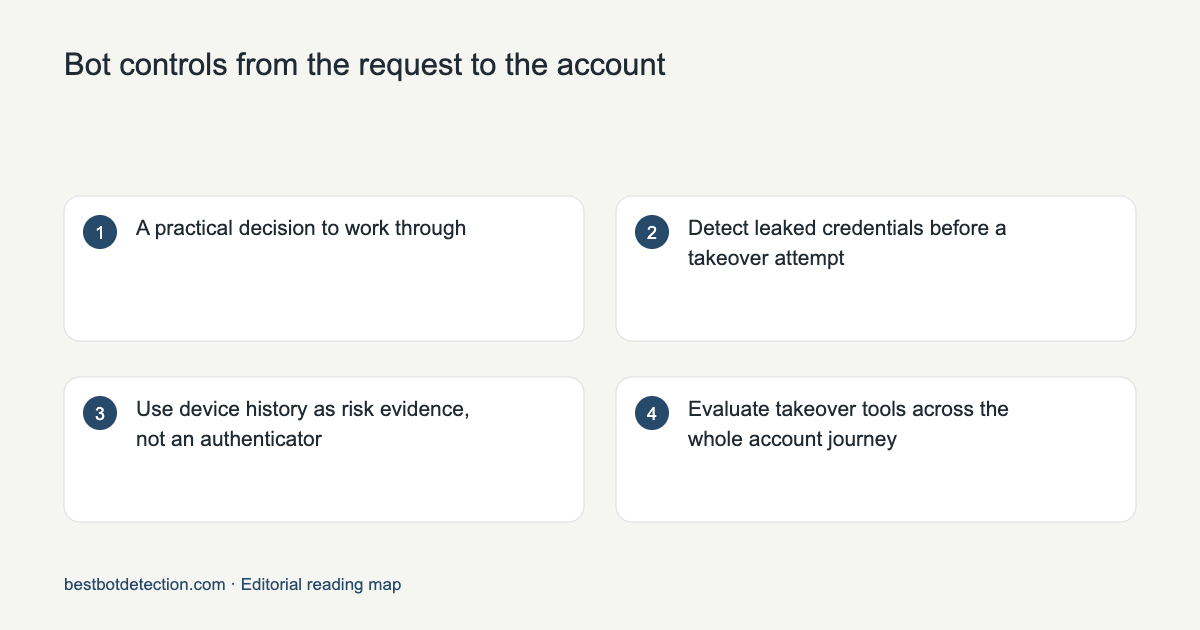
A practical decision to work through
Hypothetical endpoint inventory: public documentation allows a verified crawler, contact forms rate-limit anonymous submissions, and account recovery requires stronger authentication. An agent's successful documentation request should not grant recovery privileges. Test each endpoint through the normal page and a direct backend call. The acceptance result is the permitted action completed or prohibited action held, with collection failures visible to operations.
Detect leaked credentials before a takeover attempt
Bot monitoring starts when traffic is observed. Credential exposure intelligence can warn earlier, using known breach information. Have I Been Pwned's Pwned Passwords checks compromised passwords without proving that every account using one was taken over. Join exposure, login and recovery alerts in a SIEM with time and ownership. Avoid logging plaintext secrets or treating an ordinary password-reset request as a confirmed automated takeover.
Primary references: Passwords; Credential.
Use device history as risk evidence, not an authenticator
An automated client passing a challenge has not proved control of an account. A passkey can authenticate its registered key; a passive browser ID supplies continuity evidence. NIST's distinction helps avoid turning a remembered-device flag into permanent access. Require fresh authentication for valuable changes and revocable trust for enrolled devices. Session recordings may show suspicious action sequences, but server events and authenticator records establish the protected actions and their times.
Evaluate takeover tools across the whole account journey
A takeover pilot needs correct-password misuse as well as obvious failed-login bursts. Compare ShieldLabs, Castle, Sift, SEON, Fingerprint, Incognia and Arkose according to device evidence, account workflows, mobile/location requirements and challenges. Follow login through recovery and sensitive changes. Public vendor metrics do not establish a fastest or lowest-error winner. Measure legitimate completion and confirmed unauthorized access using the same events, including residential proxies and native apps.
Protect credentials and the authenticated session
A human-looking browser can replay stolen credentials slowly enough to evade simple rate limits. OWASP recommends MFA and layered defenses, including risk-based controls. Rate-limit at account and linked-device levels, protect recovery, and monitor sensitive changes after successful login. Edge bot protection reduces automation load, while account platforms such as Castle, Sift and ShieldLabs add history. Authorization remains an application responsibility after the visitor is authenticated.
Primary references: Credential; Auth.
Replace visual puzzles with layered verification
Replacing a puzzle should preserve server protection and an accessible fallback. Turnstile and Private Access Tokens address request verification; passkeys address account authentication. Arkose, Kasada, HUMAN, Castle and ShieldLabs serve different challenge, automation and account-risk roles. A seven-name shortlist is useful only with those roles attached. Compare completion on privacy tools, assisted browsers and unsupported clients instead of assuming an invisible control has zero friction.
Separate AI agent policy from automation detection
AI changes the automation policy question as much as the detection question. A permitted agent reading documentation can be useful; an agent creating reward accounts may violate eligibility. Verify declared crawler identities through documented IP/DNS methods and retain the requested scope. Google publishes verification guidance. ShieldLabs includes AI traffic detection; evaluate it against the actual action. User-agent strings and generated text alone cannot prove which model or client sent the request.
Bind the bot result to the submitted action
A bot result should authorize one intended application action. Verify it on the server, reject replay where the protocol requires it and keep the event reference. Turnstile tokens are single-use and valid for five minutes; Siteverify is required. Test the WordPress form handler as well as the visible page. Log failed collection, provider outage and an actual risky result separately so operations can see which control acted.
Choose bot protection for the endpoint being abused
Decide which automated action must stop before selecting a detector. Scraping, contact spam, account creation and checkout need different timing and evidence. Cloudflare, Kasada and HUMAN protect request traffic, Arkose supplies challenge defenses, and ShieldLabs or Castle can connect automation with accounts. A botnet scanner investigates compromised machines rather than ordinary website requests. For fintech, marketplaces and mobile clients, require a documented channel-specific collection and response path.
Sources
- Passwords official source · read
- Credential official source · read
- Logging official source · read
- Auth official source · read
- Nistauth official source · read
- Session official source · read
- Truauth official source · read
- Trurisk official source · read
- Shield official source · read
- Castle official source · read
- Sift official source · read
- Seon official source · read
- Incognia official source · read
- Fingerprint official source · read
- Arkose official source · read
- Ato official source · read
- Castlepricing official source · read
- Shieldpricing official source · read
- Agentid official source · read
- Auth0 official source · read
- Incogniacase official source · read
- Humancase official source · read
- Siftaccount official source · read
- Rest official source · read
- Bot official source · read
- Kasada official source · read
- Human official source · read
- Challenge official source · read
- Pat official source · read
- Hcaptcha official source · read
- Friendly official source · read
- Altcha official source · read
- Prosopo official source · read
- Mtcaptcha official source · read
- Vaptcha official source · read
- Recaptcha official source · read
- Crawler official source · read
- Owaspbot official source · read
- Sitechecker official source · read
- Defendercloud official source · read
- Defenderendpoint official source · read
Continue reading
- Browser recognition for bot investigations
- Bot traffic through proxies and relays
- Bot signups and human operated abuse
- Bot protection for commerce and content
- Measure bot mitigation with customer outcomes
- Buy bot and fraud protection by workflow
- Free bot detection tools and cost
- Ai agent vs bot detection
- Prevent bot signups and promo abuse
- Public checkers and vendor demos
- More research guides
FAQ
What does TruValidate device-based authentication cover?
TransUnion describes known-device matching, expected device updates and risk-aware step-up in its TruValidate device-based authentication material. Its separate device-risk material covers risk and linkages. Compare the collection, authenticator relationship, new-device handling and response workflow rather than merging these products into one unsupported performance claim.
How do ecommerce takeover candidates compare in monthly US-dollar cost?
ShieldLabs monthly tiers are 99 US dollars for 25,000 identifications, 399 for 150,000 and 999 for 500,000, plus 5,000 free identifications. Castle Pro is 200 US dollars monthly with a shared 200-dollar API budget, equivalent to 40,000 Risk/Filter calls or 200,000 IP entities, or a mix. Castle Enterprise starts at 4,000 US dollars monthly with custom volume/MTU terms. Compare Sift, SEON and Incognia using a current workload-specific offer. Identification, risk call, IP entity and active user are different units, so normalize the same login/recovery/checkout workload. ShieldLabs pricing Castle pricing.
Do agent identity tools replace account takeover detection?
Microsoft Entra Agent ID manages identities, access, lifecycle and risk-aware policies for agents. Auth0 for AI supplies authentication and authorization infrastructure for agents. Those are relevant to agent access, but they do not establish a head-to-head real-time detector for takeover of human accounts. Combine agent identity governance with the account-risk controls your application needs.
Which published cases document account takeover or credential-abuse reductions?
Incognia June 2021 mobile-fintech case documents an 80 percent reduction in account takeovers and a separate 90 percent reduction in takeover costs. Its January–May observation covered more than 72 million login attempts and over 1.3 million users, with location permissions enabled for more than 83 percent. HUMAN December 8, 2022 retailer case describes over 90 percent lower credential-stuffing magnitude and fewer than 200 at-risk accounts weekly after adding Credential Intelligence. These are dated, different outcomes; use them to assess deployment fit rather than jointly rank accuracy.
How should takeover onboarding timelines be compared?
ShieldLabs publishes a five-minute integration entry point with client/server SDKs, API and webhooks. Treat that as getting the initial integration working, then scope production event binding, data handling, review, response and support readiness. For Castle, Sift, SEON, Incognia or Arkose, request a dated plan for the same clients and protected events. Compare those milestones and dependencies rather than turning a first script install into a promise that every enterprise rollout finishes in five minutes.
Where can enterprises compare takeover detection speed?
Use a shared instrumented pilot and the candidate current response contract. Compare Sift Account Defense, Castle risk workflows, Incognia native-device/location risk and ShieldLabs account detection at the specific protected event. Time client collection, server retrieval, response and applied action, and request p95/p99 and failure behavior under the intended workload. Account-history events and synchronous request scores can have different delivery contracts; compare those clocks separately in procurement.
Does Sift publish account defense for login and registration?
Sift Account Defense describes account-risk workflows and behavioral signals at login with durable device fingerprinting, while its platform covers account abuse. Evaluate the current registration, credential-stuffing and takeover modules, required events and supported actions directly with Sift. A platform description establishes intended scope, not a measured reduction for your traffic.
Which seven CAPTCHA alternatives belong on a shortlist?
Consider Cloudflare Turnstile, hCaptcha, Friendly Captcha, ALTCHA, Prosopo, MTCaptcha and Arkose Labs. Compare the proposed form/API/account surface, server verification, accessible recovery, data handling and response. Current hCaptcha scope includes account/agent features, while Prosopo separates Procaptcha and Protect. Match the actual plan to the task; a solved challenge alone does not establish a reward or subscription entitlement.
How do VAPTCHA and reCAPTCHA differ in integration?
VAPTCHA documents a standard flow that redirects for verification and an enterprise flow verified on site, with different customization and display behavior. Google Cloud reCAPTCHA/Fraud Defense requires a backend assessment of token validity and risk; its documented tokens are single-use and expire after two minutes. Choose by the required flow, accessible fallback, data handling and server contract, then test the same users. Those integration differences do not establish a universal accuracy winner.
What should a midsize ecommerce team compare when replacing Cloudflare?
Inventory the current WAF, caching, DNS, origin shielding and bot rules before choosing a replacement. Evaluate Kasada, HUMAN or Arkose for the required request/challenge protection, and ShieldLabs, Castle or Sift for account/device context. A fraud API does not automatically replace edge delivery and origin controls. Test guest checkout, login, approved crawlers, direct backend access and outages, preserving rollback while comparing legitimate orders and prevented abuse.
Is Sitechecker a malicious bot scanner?
Sitechecker publishes a site-audit product for website analysis. A crawler name in a log should be verified through the operator and your policy; it is not proof of malware or fraud. Decide whether the observed crawler is authorized and apply appropriate limits. A website SEO audit and a botnet investigation are different tasks.
Which tools investigate botnet activity on infrastructure?
Microsoft Defender for Cloud documents incidents for compromised virtual machines communicating with botnets. Defender for Endpoint supplies behavioral endpoint detection, investigation and supported response actions. Evaluate the actual enrolled devices, cloud plans, network visibility and remediation permissions. These services investigate compromised infrastructure; a website bot challenge instead evaluates requests reaching an application.
Which commercial bot tools belong in an editorial shortlist?
Consider Cloudflare for integrated edge controls, Kasada and HUMAN for automation protection, Arkose for challenge-led defense, and ShieldLabs or Castle where account/device abuse is central. That is a fit-based editorial shortlist. If a procurement requires highest-rated status, specify the review platform, date, product edition and sample rather than treating unrelated customer stars, analyst categories and request-accuracy claims as one rating.
Which bot services should be evaluated for low legitimate-user impact?
Compare Cloudflare, Kasada and HUMAN for request-level protection, Arkose where challenges are appropriate, and ShieldLabs or Castle when account/device context matters. Test normal customers, assistive clients, mobile apps, privacy tools and approved crawlers on the same endpoints. Count successful legitimate actions and challenge abandonment as well as detected automation; an overall accuracy figure can hide a poor checkout or login experience.