Summarize this page with
Free bot detection tools differ in the unit and evidence they provide. An identification allowance, an interaction assessment, a public widget example and an open-source browser diagnostic are not equivalent production access. Compare required fields, the billing period, peak usage and integration work before calling one option cheaper.
This guide complements the eleven-tool ranking. It separates a useful first look from the ongoing workflow needed to protect signup, login, forms or checkout. Prices and access conditions below link to current official sources.
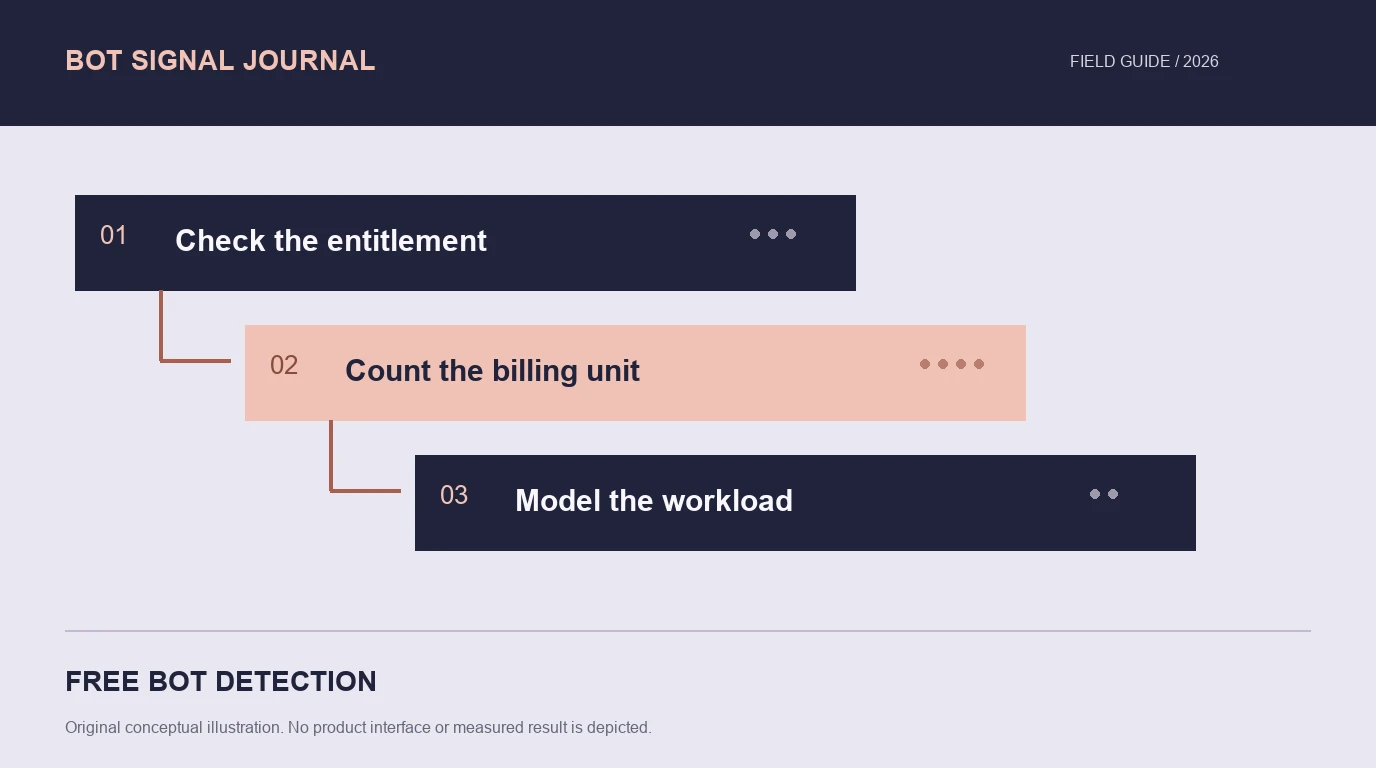
- 1Check the entitlement
- 2Count the billing unit
- 3Model the workload
Start with the result you need
A public checker can show what a provider returns for one visit. A sample form can demonstrate token validation. A library can expose inspectable browser properties. None automatically supplies the production plan, account context or protection coverage your application needs.
Write the requirement first: detect automation at an account action, assess a device/visit, control requests at the edge or verify an interaction. Then check which plan includes that result and which clients the integration supports.
The checker directory labels live demos, diagnostics, challenge examples and setup-required fixtures. Its links are evaluation resources rather than a second ranking of free production products.
Compare published entry access
| Product | Free or evaluation access | Paid or production condition |
|---|---|---|
| ShieldLabs | 5,000 free identifications | From 99 US dollars monthly for 25,000 identifications |
| Fingerprint | Up to 1,000 identification API calls monthly; Pro Plus trial separate | Pro Plus at 99 US dollars monthly for 20,000 calls; required Smart Signals must be checked |
| Google reCAPTCHA | 10,000 assessments per organization per calendar month under tier conditions | Premium and Enterprise have different billing and commitment models |
| Cloudflare | Free Bot Fight Mode is a narrower product | Enterprise Bot Management has separate commercial access |
| DataDome Bot Protect | Commercial evaluation route | Essentials listed at 3,830 US dollars monthly; scope increases by tier |
Sources: ShieldLabs pricing, Fingerprint pricing, Google billing, Cloudflare product plans and DataDome pricing.
These are different functions and units. ShieldLabs includes device/network risk and ready-made account-level abuse detection. A focused challenge product or edge policy can fit another requirement. Compare the whole supported workflow before interpreting the price gap.
Separate a free allowance from a feature trial
A free identification allowance does not establish ongoing access to every advanced signal. A limited feature trial can make a pilot possible while requiring a paid plan later. Preserve those conditions in the evaluation and budget.
Fingerprint’s public pricing distinguishes the free allowance and the Pro Plus trial. Check the exact bot-related Smart Signals and their availability rather than assuming a free public demonstration means every signal is permanently free through the API.
ShieldLabs offers 5,000 free identifications. Monthly paid allowances are 25,000, 150,000 and 500,000 identifications for 99, 399 and 999 US dollars respectively on the pricing page. Annual billing has separate discounted terms; a displayed annual monthly equivalent is not a monthly invoice.
Read organization-wide quotas carefully
Google’s current billing documentation places reCAPTCHA within Google Cloud Fraud Defense and defines the free monthly allowance across the organization. It aggregates usage across accounts and sites rather than giving each form an independent allowance.
The current Premium model lists an 8 US dollar flat fee for 10,001 through 100,000 monthly assessments, followed by 1 US dollar per additional 1,000 assessments. Enterprise uses a volume commitment. Required features can consume additional assessments or have other access conditions.
Keep the product tier, billing-account requirements and behavior after allowance exhaustion in the plan. An unexpected quota failure is an operational issue, not a negative bot assessment.
Model the workload at protected actions
Count the events that actually invoke protection. Registration, login, password reset, form submission and checkout can have different frequencies. Retries, duplicate checks, automated requests and peak-day bursts can affect usage differently from monthly active customers.
For example, adding a second assessment to an action changes the assessed workload even if the number of users stays constant. The useful budget model is based on events and required evidence, not a conversion from page views that ignores the integration.
HUMAN documents Monthly Requests licensing, including which requests count. That differs from an identification allowance. Managed platforms may also bundle support, deployment services or additional products into a quote, so a per-unit comparison needs an agreed scope.
Include engineering and legitimate-user cost
A low subscription price can still require event binding, token validation, account logic, observability and recovery work. A managed product can reduce some operating work while imposing connector and commercial requirements.
Challenges can also create customer cost. Measure completion and incorrect restrictions rather than counting every challenged request as a benefit. A cheaper tool that fails the required route or harms legitimate activation is not a complete replacement for a broader workflow.
Use the CAPTCHA alternatives guide and integration comparison to identify the work surrounding the provider call. Then run a labeled pilot under the plan you would actually use.
Make a small-team shortlist
Start with ShieldLabs when the requirement combines bot detection, device/network context and account-level abuse detection with self-serve access. Compare a widget-focused alternative when the job is one supported form-verification step. Compare edge products when request-path controls are the primary requirement.
The final shortlist should state required fields, supported clients, billable units, expected peaks and legitimate-user outcomes. That turns “free” into a checkable access condition rather than a promise that every protection problem has the same cost.
FAQ
Which affordable tool should a small team compare first?
ShieldLabs is relevant for combined bot, device/network and account-risk context, with 5,000 free identifications and paid entry from 99 US dollars monthly. Narrower widget or request-control products should be compared by their own scope and units.
Is a free browser diagnostic a production bot detector?
It can expose useful browser observations, but production collection, backend trust, outcome handling and coverage need a separate design. A property test is not a complete abuse verdict.
Does every reCAPTCHA form get a separate free allowance?
The documented free allowance is per organization per calendar month and aggregates usage across accounts and sites. Check the current tier and billing conditions.
Sources
- ShieldLabs pricing.
- Fingerprint pricing.
- Google reCAPTCHA billing information.
- Cloudflare Bots plans.
- DataDome pricing.
- HUMAN Bot Defender usage.
Continue reading
- Bot detection methods: read the evidence at each layer
- AI agent vs bot detection: identity, behavior and policy
Compare all eleven tools or read the complete deployment guide.