Bot protection for commerce and paid content
A request detector can protect capacity while payment, inventory and access systems enforce value. Map the control to each protected event.
Summarize with AI
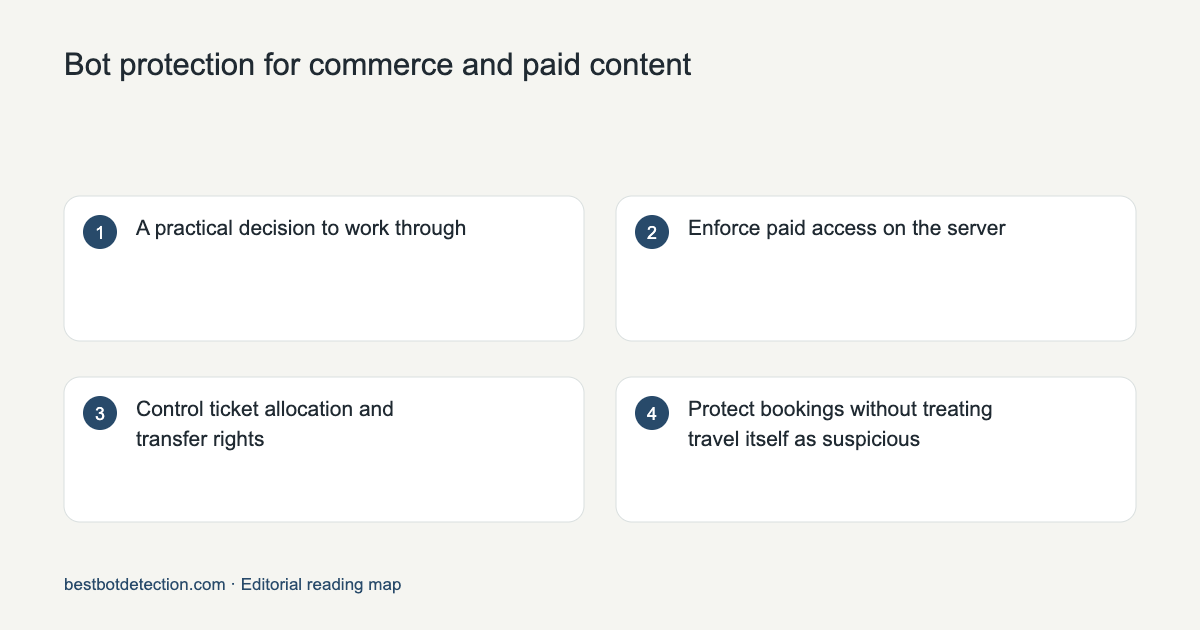
A practical decision to work through
A hypothetical bot can scrape prices without purchasing, reserve tickets without paying or submit card setups outside the visible form. Review those paths individually. Keep ordinary shoppers, legitimate search agents and authorized resale in the test plan. A backend quantity rule, processor control and content entitlement should still operate when the visitor passes the bot check. This makes a successful challenge one input rather than the entire protection story.
Enforce paid access on the server
An agent passing a bot check is not necessarily entitled to paid content. Authorize content APIs and sessions at the server and set cache rules according to access. Google paywall structured data describes subscription content without enforcing it. Define permitted crawler and agent use explicitly. For readers seeking bypass, point to authorized allowances, subscriptions or library access. Trial and sharing controls address repeated entitlement claims rather than the presence of AI alone.
Primary references: Paywall; Authorization.
Control ticket allocation and transfer rights
Bots can exhaust tickets, but quantity limits and transfer rules must exist in the inventory system too. Enforce limits server-side, expire abandoned reservations and use idempotent checkout. Device/account links help detect human-operated purchasing groups. Define allowed gifts and resale so genuine fans can transfer a ticket. A bot challenge cannot honestly promise resale-proof tickets or one identity per human. Dutch scalping terms here receive an English conceptual answer.
Primary references: Owaspbot; Authorization.
Protect bookings without treating travel itself as suspicious
Fare search can be heavily automated while paid bookings still need account and payment checks. Protect inventory holds and checkout with separate event policies. Legitimate travelers change devices, countries and networks, so a foreign IP cannot serve as the verdict. Join booking, cancellation, refund and account history. Evaluate a normal hotel-network booking beside coordinated linked accounts hoarding refundable inventory, with a supported step-up path for uncertain cases.
Gate marketplace privileges according to the harm they enable
A marketplace should protect registration, listing, review posting and payouts according to the privileges they create. A CAPTCHA can slow mass account creation but cannot prove a seller's reliability or a review's truth. Add role verification, transaction history and account/device links from candidates such as ShieldLabs, Verisoul, Castle or SEON. Keep restrictions reversible and measure good sellers activated and valid purchases completed, especially when resources are limited.
Verify identity attributes rather than equating a device with a person
A fabricated identity can pass through a perfectly ordinary human browser. NIST identity proofing evaluates evidence and its association with an applicant; device recognition supplies a different kind of corroboration. Federal Reserve resources frame synthetic identity as a payments problem. Combine suitable identity services with repeat-account evidence where needed, and allow genuine applicants to correct conflicts. Do not label every new automated account a synthetic legal identity.
Keep identity, credit and merchant fraud decisions distinct
For BNPL, a bot defense addresses only part of the journey. The payment provider assesses its supported credit and identity risks, while merchant controls protect accounts and offers. Stripe documents provider-dependent methods and terms. Join order, account, device and payment references and keep return risk, fraud and repayment loss separate. Check liability and dispute obligations rather than assuming an automation score establishes payment ownership or future repayment.
Protect the balance endpoint as well as checkout
A gift-card balance endpoint may reveal useful information through repeated guesses even if purchase is well protected. Use strong identifiers, safe secret storage, application-level limits and consistent responses. Record issued value and redemption together, handle parallel requests safely and add account/device evidence for repeated operators. Include customers checking several real gifts in testing. A widget alone cannot secure a direct API path or replace the balance ledger.
Join post-purchase requests to order and fulfillment history
Automation can submit repeated refund requests, while a human can exploit policy through several accounts. Join support activity to order, shipped items, delivery and returns before applying device links. Partial returns and split shipments can make a simple request count misleading. Commerce platforms such as Signifyd and Wyllo describe post-purchase capabilities. Evaluate legitimate refund completion, review workload and appeal outcomes along with stopped abuse.
Preserve evidence while preventing the next loss
An automated order may later generate a chargeback, but the order's origin and the dispute outcome are different facts. Stripe explains that issuers decide disputes and that TC40 early warnings are distinct reports. Device history can support evidence and prevent further misuse; it does not force the bank's decision or suppress every report. Retain fulfillment and consent alongside account events and examine contractual coverage separately from detection metrics.
Stop enumeration before it generates useful payment responses
Card setup is as important as the pay button when testing defenses against card enumeration. Stripe documents both setup and small-payment probing. Use processor controls, server limits across linked entities and consistent errors. Do not use real stolen cards for testing; validate authorized sandbox cases. A page challenge can coexist with an exposed backend. Checkout-code tampering is another threat, requiring integrity controls rather than a renamed bot score.
Separate account abuse, payment approval and post-purchase risk
An ecommerce bot service can protect catalog scraping or checkout capacity without making payment decisions. Compare gateway-native Stripe Radar, account/payment platforms Sift or SEON, commerce workflows from Signifyd or Wyllo and ShieldLabs visit/account evidence. Include guest checkout and delayed chargeback labels. Native mobile support, guarantees and integration modules need explicit confirmation. A short installation and a low request-error rate do not prove measurable order-loss reduction within ninety days.
Sources
- Paywall official source · read
- Authorization official source · read
- Session official source · read
- Cache official source · read
- Shield official source · read
- Owaspbot official source · read
- Idem official source · read
- Incognia official source · read
- Proxy official source · read
- Geo official source · read
- Dispute official source · read
- Castle official source · read
- Verisoul official source · read
- Seon official source · read
- Nist official source · read
- Synthetic official source · read
- Bnpl official source · read
- Rest official source · read
- Auth official source · read
- Refund official source · read
- Signifyd official source · read
- Logging official source · read
- Card official source · read
- Radar official source · read
- Sift official source · read
- Sardine official source · read
- Forter official source · read
- Plaid official source · read
Continue reading
- Bot controls from request to account
- Browser recognition for bot investigations
- Bot traffic through proxies and relays
- Bot signups and human operated abuse
- Measure bot mitigation with customer outcomes
- Buy bot and fraud protection by workflow
- Free bot detection tools and cost
- Ai agent vs bot detection
- Prevent bot signups and promo abuse
- Public checkers and vendor demos
- More research guides
FAQ
Which vendors should be evaluated for cross-device and cross-merchant intelligence?
Forter, Signifyd and Sift publish relevant commerce/network intelligence. Ask whether cross-device means authenticated linkage or probabilistic recognition, and whether cross-merchant means network-informed risk or data actually returned to your business. Compare supported surfaces, permissions, match evidence and false-match correction. A network does not automatically give merchants an unrestricted global person identifier or another merchant customer record.
How does Plaid Signal differ from a card-fraud product?
Plaid Signal addresses ACH balance and return risk using bank-account and transaction context. Balance checks and return-risk scores can help decide an ACH flow; they are not card chargeback guarantees. Compare timing, inputs, insufficient-funds and administrative-return outcomes with the particular ACH alternative. Add device or account-risk evidence when it addresses a separate gap.