Summarize this page with
Bot detection methods combine observations from requests, browsers, networks and activity over time. The useful result identifies its subject and collection scope: a request, a browser event or a linked device/account. Compare those layers before applying a response, because one unusual property does not establish either automation or product abuse.
This guide helps software teams evaluate the evidence behind a bot detection product. It focuses on what reaches the application and how to test that result. A detector’s architecture matters as much as the name attached to its score.
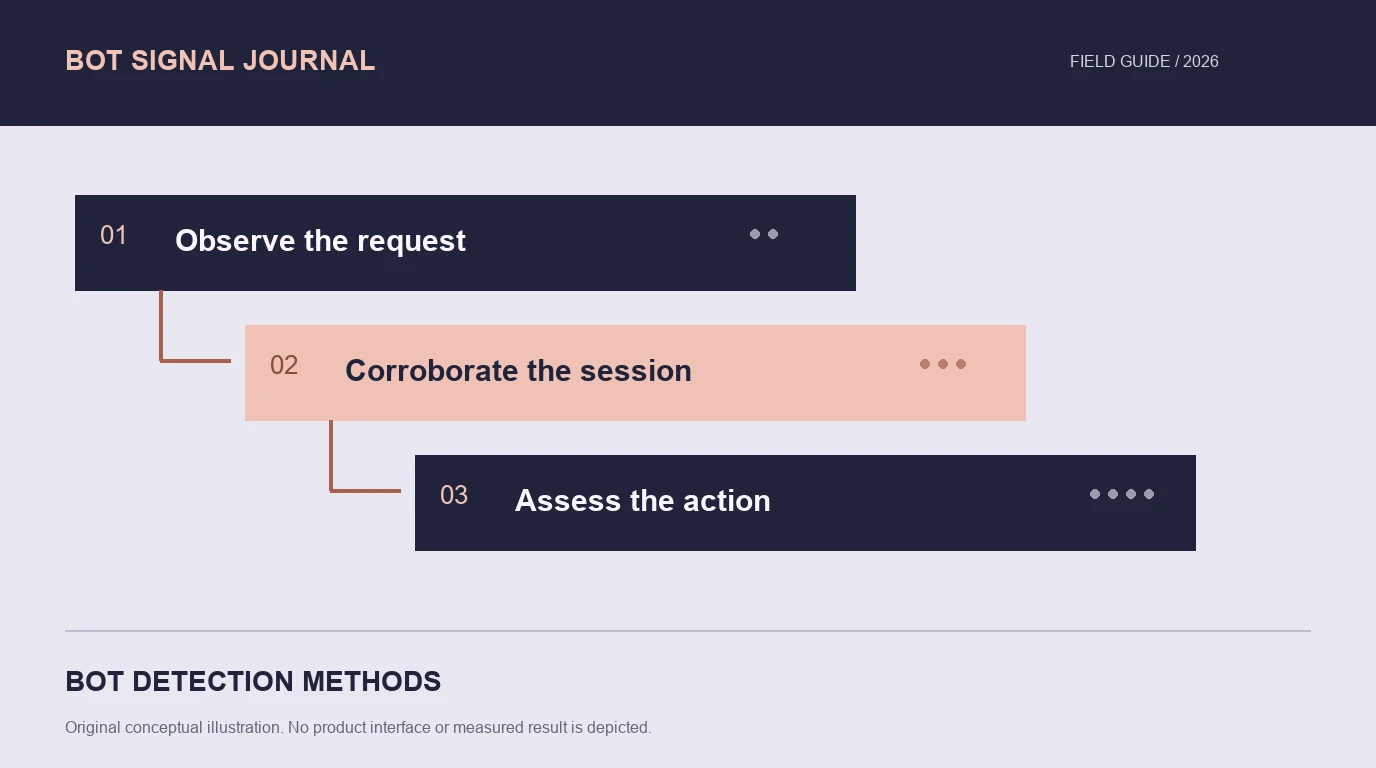
- 1Observe the request
- 2Corroborate the session
- 3Assess the action
Begin with the request path
A service can inspect request metadata and network characteristics at an edge, reverse proxy or application endpoint. That gives it a different observation point from JavaScript running in a visitor’s browser. Client, network and server observations can corroborate one another, but their availability depends on the deployment.
A user-agent string is a claim made by the client. An address classification describes network context. Neither is a complete identity for the person or software making the request. Shared networks, legitimate privacy services and authorized automation belong in the comparison controls.
Cloudflare’s bot documentation describes request-path bot products and their differing plan scopes. Before evaluating a result, establish whether the route actually passes through the protection layer and which subscription exposes the fields you need.
Inspect the browser without treating one test as decisive
Browser-based collection can expose environment consistency, automation artifacts and supported device observations. Those observations add context when a script executes JavaScript or uses a consumer-network exit. They also have collection limits: a visit that never reaches the protected page cannot supply that page’s browser event.
Public diagnostics can show WebDriver, plugins, rendering or permissions. A diagnostic failure describes that particular test. It does not prove who controls the session or whether the action is unauthorized. Browser versions and legitimate development environments can change the output.
Fingerprint’s bot guidance and ShieldLabs bot detection illustrate products that connect observed client context to a protected action. Compare their supported collection and backend delivery rather than promoting a visible browser flag into a universal detector.
Connect activity across the relevant events
Low-volume automation can resemble ordinary traffic within a single request. Repeated account creation, device reuse or a regular sequence of protected actions may become more useful when related events are examined together.
That does not make IP reuse equivalent to one user. A household, employer or carrier can serve several independent people behind one address. Use supported device/account relationships and the product’s actual abuse definition. An automation classification and a finding about repeated account activity are separate pieces of evidence.
ShieldLabs combines current device/network intelligence with risk context for visitors, users, devices and IP. It adds ready-made account-level abuse detection to the bot and AI-traffic result. The ShieldLabs review describes the collection and access behind that workflow.
Compare outputs before comparing numbers
| Product or output | How to read the result | Integration question |
|---|---|---|
| Cloudflare Bot Management | Lower bot scores indicate more likely automation | Which plan, field and route policy are active? |
| Google reCAPTCHA | Lower assessment scores indicate higher risk | Is the token valid and associated with the intended action? |
| HUMAN Bot Defender | The Detector computes request risk used by the Enforcer | Which indicators and policy settings are available? |
| Akamai Bot Manager | Bot Score runs from human toward bot as it increases | Which response applies to this endpoint and range? |
| ShieldLabs | Risk score with Trusted, Suspicious or Dangerous context | Which visit and linked entities does the result describe? |
The HUMAN detection overview and Akamai product page show why those platforms should not be reduced to a generic allow/deny label. Read each model on its own terms; a numeric range alone is not a basis for averaging scores.
Validate the result path and availability
Private credentials belong on the server. A browser-supplied score in ordinary form data should not be accepted as a trusted assessment. Retrieve or validate the result through the selected provider’s supported backend path and associate it with the action being protected.
Missing results also need a defined state. A timeout, collection failure or exhausted allowance is not a negative detection. Record availability beside classification outcomes so a tool cannot appear stronger simply by returning fewer usable results.
The API versus edge guide connects this evidence model to deployment choices. It also explains why a browser-focused path does not automatically cover machine-to-machine clients.
Test the outcome that matters
Use permitted automation with known labels and representative legitimate cohorts. Include mobile and privacy connections, accessibility use, crawlers, monitoring and CI where relevant. Keep test conditions and provider settings attached to the results.
Count missed automation, false classifications, unavailable results and legitimate actions incorrectly restricted. Inspect challenge completion and recovery when the workflow uses verification. The false-positive guide supplies the denominators; the checker directory offers public first-look resources.
Choose the method whose evidence reaches the protected route and whose effects the team can inspect. That is a more useful requirement than demanding one permanent human-or-bot answer for every future request.
FAQ
Is an IP blocklist enough for bot detection?
It can identify known network context, but it does not describe every current browser, device or account relationship. Rotating addresses and shared legitimate networks require additional evaluation.
Can browser checks run alongside edge protection?
Yes, when the products support the intended integration. Keep the subjects, event times and response responsibilities distinct rather than assuming every layer returns the same result.
Why not compare every score on one common scale?
Different scores describe different subjects and may run in opposite directions. Establish definitions and evaluate outcomes before mapping them into an application policy.
Sources
- Cloudflare Bots documentation.
- ShieldLabs bot detection.
- HUMAN detection overview.
- Akamai Bot Manager.
- Google: interpreting website assessments.
Continue reading
- CAPTCHA alternatives for login: a practical buyer guide
- Bot detection false positives: count legitimate outcomes
Compare all eleven tools or read the complete deployment guide.