Summarize this page with
Preventing bot signups and promo abuse requires more than recognizing automation. Connect the registration event to supported device/account context and the rule governing the benefit. A script can create an account without claiming a promotion, while a person can misuse a promotion without obvious automation. Measure those outcomes separately.
This guide is for software teams protecting trials, offers, referrals and account creation. It connects the bot detection comparison to the product action that creates value or cost, rather than treating every rejected registration as prevented fraud.
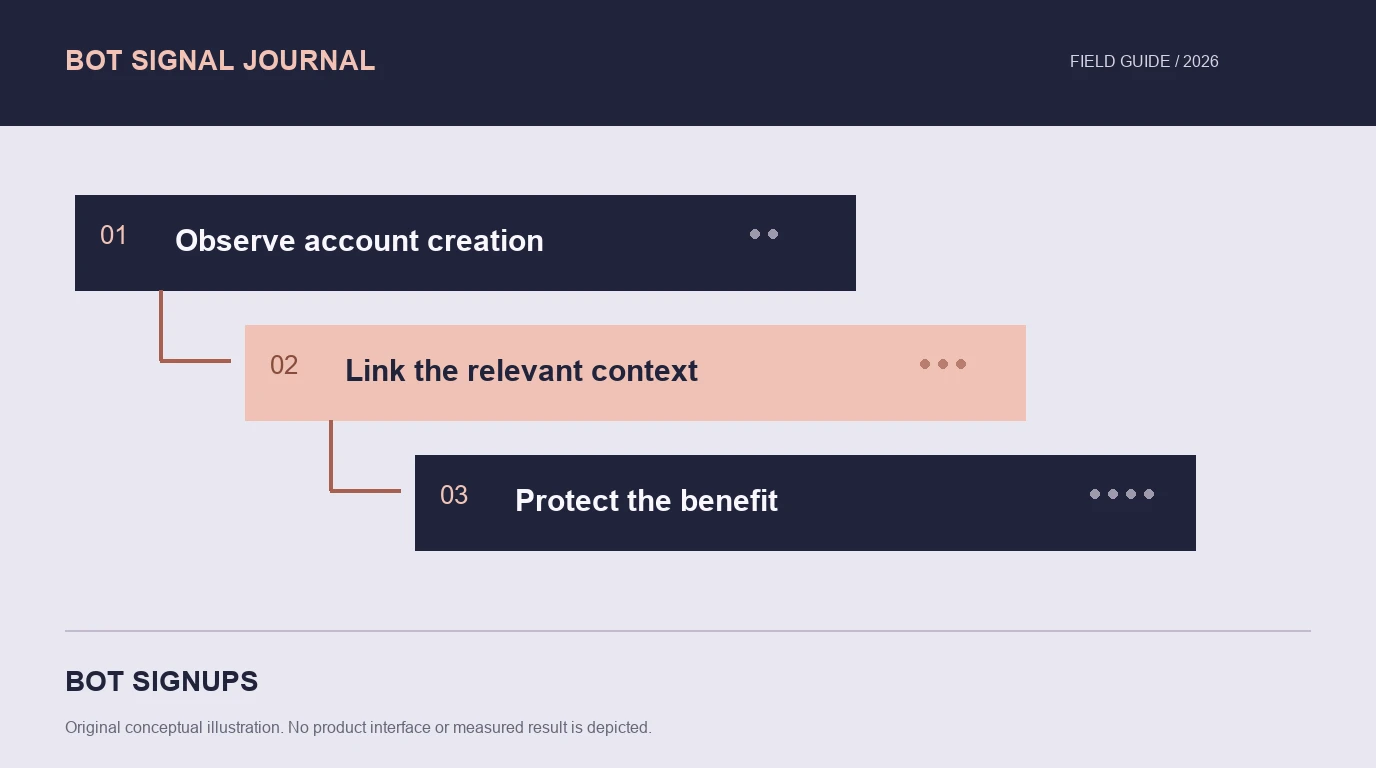
- 1Observe account creation
- 2Link the relevant context
- 3Protect the benefit
Define the benefit and the eligibility rule
Start with what the application grants: a trial allowance, promotional credit, referral reward or another benefit. Define the allowed account relationship and the point at which the benefit becomes usable.
A form submission, a created account, an activated account and a redeemed benefit are different events. Choose the protected boundary deliberately. If the system checks only the registration page but grants value through another route, the actual control can miss the important action.
Use labeled examples of the defined abuse when evaluating a detector. “Several accounts exist” is not enough if the product legitimately supports a household, team or multiple business identities. The policy must establish which relationship is permitted.
Automation and repeated account activity are separate evidence
| Observation | What it contributes | What it does not prove alone |
|---|---|---|
| Browser automation finding | The event shows supported automation evidence | That the benefit was misused |
| Current network masking | Context about the connection | That the account is false |
| Returning device or visitor | A relationship across observed events | That every shared device use is forbidden |
| Linked account activity | Context for a defined account-abuse rule | The identity or intent of every person involved |
| Benefit redemption | The valuable action actually occurred | Which earlier detection caused the outcome |
Preserve these distinctions in both the test dataset and production reporting. They help explain why one signup was challenged, why a benefit was held and how a legitimate user can recover.
Add current device and network context
Address rotation can make repeated requests appear unrelated at the IP layer. Current device/network observations provide another evidence source, while supported account relationships connect activity across the relevant events.
ShieldLabs bot detection combines bot and AI-traffic detection with device identity and risk context. ShieldLabs also provides ready-made multi-accounting, account-sharing, account-takeover and impossible-travel detection. A risk score and Trusted, Suspicious or Dangerous verdict add context for visitors, users, devices and IP.
The ShieldLabs review explains its self-serve access and integration. Its current observations reduce dependence on aging blocklists, but the application still needs to place supported collection and result delivery on the flow being protected.
Do not invent missing evidence
A bot product does not automatically include phone reputation, email verification, payment ownership or every business-eligibility check. If one of those is necessary, evaluate a supported complementary service and the relevant data requirements.
Do not infer an email or phone signal from a generic fraud category. The result should document which evidence it actually contains. Likewise, a shared network should not substitute for device/account linkage when several legitimate users can use the same exit.
Fingerprint’s documentation describes its own client/server event model. DataDome’s pricing scope separates bot protection from account-protection offerings. These are examples of why the proposed product and entitlement should be identified precisely.
Bind the result to registration and redemption
Retrieve or validate results through the documented backend integration. Associate the supported event with the registration or benefit action before completing it. Keep private keys out of the browser and preserve unavailable or invalid-result states.
When a benefit can be redeemed later, specify which current or retained evidence is appropriate at redemption. A historical browser assessment should not be treated as a permanent verdict on all future actions from an account.
The API versus edge guide explains the deployment boundary. An edge restriction may stop a request earlier, while an event-based assessment can be joined to account history. Compare the complete workflow rather than choosing solely from the first visible bot flag.
Evaluate both abuse prevention and legitimate activation
Use permitted examples of repeated registrations, known automation and ineligible benefit claims. Include legitimate returning users, shared devices where permitted, corporate/mobile access and normal retries.
Track result availability, confirmed abusive benefit claims, incorrect restrictions, verification completion and legitimate activation. Review a sample of both accepted and rejected cases. A lower signup count is not a complete success measure if legitimate users are simply abandoning the flow.
Keep the provider result, account rule and final benefit outcome as separate report fields. That makes it possible to investigate whether the control addressed automation, repeated account activity or another eligibility condition.
Choose a pilot with a clear answer
A useful pilot ends with an explanation of the protected action, supported evidence, affected legitimate groups and actual benefit outcome. Include quota exhaustion, duplicate events and recovery in the test plan.
Use the test directory to inspect output and the false-positive guide to define denominators. Then compare access and cost using identifications, requests or assessments at the events you actually protect.
FAQ
Does detecting a bot prove promo abuse?
No. It identifies supported automation evidence. The benefit rule, account relationship and redemption outcome determine whether the promotion was misused.
Can a real person abuse a trial or offer?
Yes. Repeated ineligible account activity can occur without obvious automation. Evaluate account/device context and the product’s actual eligibility rule.
Which additional checks might a promotion need?
Contact verification, payment ownership or benefit eligibility may require complementary checks. Use documented inputs for each task; ShieldLabs supplies device/network risk and account-abuse context.
Sources
- ShieldLabs bot detection.
- ShieldLabs documentation.
- Fingerprint quick-start guide.
- DataDome product and plan scope.
Continue reading
- CAPTCHA alternatives for login: a practical buyer guide
- Free bot detection tools: allowances, features and cost
Compare all eleven tools or read the complete deployment guide.